IELTS Speaking Test Format Explained (2026 Update)
TL;DR / Quick Summary
Many candidates find the IELTS speaking test the most nerve-wracking part of the exam. Unlike reading or listening, it puts you face-to-face with an examiner, speaking in real time, with no second chances on a badly worded sentence. The good news is that this test follows a fixed, published format that you can prepare for thoroughly. Once you understand exactly what happens in each of the three parts, and what examiners actually listen for, the test becomes far less intimidating.
This guide covers the full format, part-by-part strategy, and the four marking criteria that determine your band score.
What Is the IELTS Speaking Test Format?
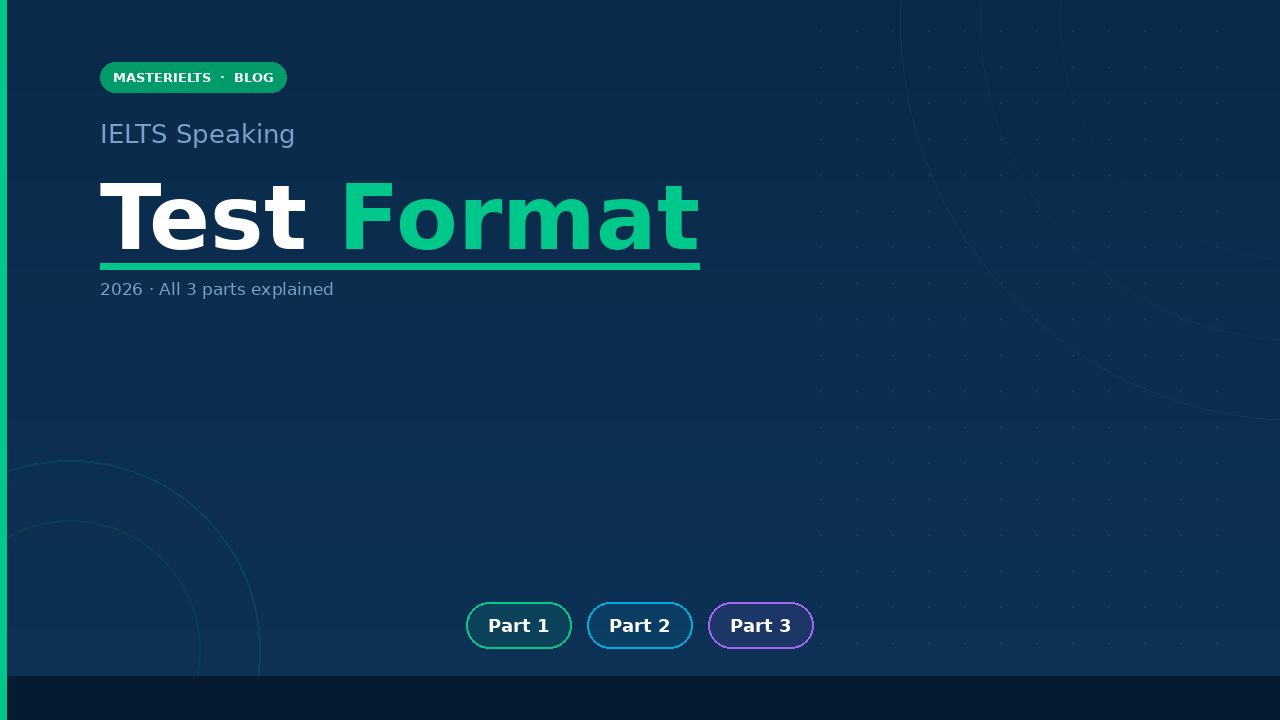
The test lasts 11 to 14 minutes and takes place in a private room with a certified examiner. It is identical for both Academic and General Training candidates, so everything here applies regardless of which version you are sitting.
The session is recorded for quality assurance purposes. The examiner follows a set script and cannot give you feedback during the test, but they are trained to make the conversation feel as natural as possible.
There are three parts, each with a different purpose and a different demand on your language skills:

The progression is deliberate. You begin with familiar, personal topics to settle your nerves, move to a prepared monologue, then finish with a more demanding conceptual discussion. If you understand the logic of this structure, you can use each part to build momentum into the next.
For a broader overview of the entire speaking component, including sample questions and model answers, see the ultimate IELTS speaking guide at Master IELTS.
IELTS Speaking Test Part 1: The Personal Interview
The examiner will ask questions about your life: where you live, your studies or work, your hobbies, daily routines, and preferences. This section lasts roughly four to five minutes.
The single biggest mistake candidates make in Part 1 is giving one-word or very short answers. If you say "Yes" or "Not really" and wait, the examiner cannot hear your fluency, grammar, or vocabulary. There is nothing to score. Aim to speak two to four sentences per answer, using a simple pattern: state your position, give a reason, add a brief example or detail.
For instance, if asked "Do you enjoy cooking?", a weak response is "Sometimes." A stronger response is: "Yes, I do, though I only really cook at weekends. I find it quite relaxing after a busy week, and I've been trying to learn a few Thai dishes recently."
Common Part 1 topics include home and accommodation, work or study, hobbies, food and eating habits, transport, and technology. You do not need to memorise answers, but you should have thought through your own opinions on topics like these so you can speak naturally without long pauses.
If you do not understand a question, ask the examiner to repeat or clarify. Say something like "Could you repeat that, please?" or "Could you explain what you mean by that word?" This is perfectly acceptable and shows communicative confidence rather than weakness.
IELTS Speaking Test Part 2: The Individual Long Turn
The examiner hands you a cue card describing a topic and three or four bullet points. You have one minute to prepare, then one to two minutes to speak. You will also receive a pencil and paper for notes.
A typical cue card might say: "Describe a skill you would like to learn. Say what the skill is, why you want to learn it, how you would go about learning it, and explain how it would benefit you."
Use the preparation minute well. Write single keywords, not full sentences. Full sentences tempt you to read from your notes, which collapses your fluency score immediately. Jot down one word per bullet point, perhaps a connecting phrase, and your opening sentence. Then speak from those prompts, not from a script.
Common cue card topics, based on Cambridge IELTS sample tasks (Source: Cambridge Assessment English / IELTS.org), include people you admire, places you have visited, objects with personal significance, memorable experiences, and skills or hobbies. It is worth having two or three mental "templates" for each category, so you can adapt quickly to whichever version appears on test day.
Pace yourself through the bullet points at roughly 25 to 30 seconds each. If you finish early, the examiner will ask a brief follow-up question, which still counts as Part 2 content.
Do not memorise and rehearse a complete response. Examiners hear memorised answers regularly and are trained to recognise them. A memorised answer typically drops scores across fluency and vocabulary because it lacks the spontaneous qualities examiners are listening for.
The Four Marking Criteria For The IELTS Speaking Test
Your score is calculated across four equally weighted criteria, each worth 25% of your final mark. Understanding these is the fastest way to identify where to focus your preparation. For a detailed breakdown of how each band score is assessed, the IELTS speaking band descriptors guide at Master IELTS explains exactly what examiners look for at each level.
Fluency and coherence refers to the smoothness of your speech and the logical flow of your ideas. Fluency is not speed. It means maintaining forward momentum, recovering naturally from slips, and not relying on long pauses or repeated filler sounds. Coherence means your ideas connect and your listener can follow your thinking without effort.
Lexical resource covers the range and accuracy of your vocabulary. This does not mean using rare or overly academic words. It means varying your word choices, using topic-relevant language, and demonstrating that you know how words combine naturally (for example, "a demanding job" rather than "a big job").
Grammatical range and accuracy rewards candidates who use a variety of sentence structures, not just simple sentences. You are expected to use complex sentences, conditionals, passive constructions, and relative clauses where they arise naturally. Occasional errors are fine. Consistent errors in basic structures, such as subject-verb agreement, lower scores more than an occasional slip in an advanced structure.
Pronunciation does not require a British or American accent. Any accent is acceptable as long as your speech is clear and understandable. Examiners listen for accurate word stress, clear consonant and vowel sounds, and natural intonation. Monotone delivery and consistently misplaced stress are the most common issues at the intermediate level.
Part 3: The Abstract Discussion
Part 3 follows directly from your Part 2 topic. If your cue card was about a skill you want to learn, Part 3 questions might explore why people value learning new skills throughout their lives, or whether governments should fund adult education programmes.
These questions are open-ended and often ask you to analyse, compare, speculate, or give an opinion on a broad societal theme. There is no correct answer. The examiner is assessing how you express ideas, not what you believe.
The most effective strategy for Part 3 is to treat it as a genuine conversation. Use discourse markers that signal your thinking: "That's an interesting question. I suppose the main reason is...", "On the other hand, I can see why some people might argue...", or "In the long run, I think...". Pausing briefly to think is entirely natural and does not hurt your fluency score, provided you recover and speak smoothly.
One gap that most IELTS guides leave unaddressed is what to do when a question feels too abstract or outside your experience. The technique that works consistently is to rephrase the abstract idea in concrete terms, anchor it to an example you do know, and then answer from there. For instance, if asked "How do global economic trends affect people's attitudes to work?", you might say: "That's quite a broad question. From what I've seen in my own field, the shift toward remote working has definitely changed how people think about job security..." This approach demonstrates both coherence and the ability to manage a conversation, both of which examiners reward.
How to Prepare Effectively
A few principles are worth stating plainly because they contradict common assumptions.
Memorising model answers hurts your score. British Council guidance states that practice materials "do not represent model answers" and warns explicitly against over-imitation (Source: British Council Take IELTS, takeielts.britishcouncil.org). Your preparation should build your ability to generate language spontaneously, not your ability to recall pre-written text.
Recording yourself is the most efficient self-study tool available. Record a full mock test, then listen back and assess yourself honestly against the four criteria. Where do you pause longest? Where does your vocabulary feel limited? Where do you rush or speak unclearly? Your own recordings reveal gaps that no amount of reading about the test will show you.
Official practice materials from the British Council and IELTS Organisation (ielts.org) represent the closest approximation to real test content. Use these as your primary practice source rather than unofficial or AI-generated materials, which may not reflect the actual test format or difficulty.
Speaking English consistently in the days before your test matters. Fluency is a physical habit as much as a cognitive one. If you only speak English once a week, your mouth and brain are not used to sustaining English output for 14 minutes. Daily speaking practice, even 20 to 30 minutes, makes a meaningful difference.
Frequently asked questions
How long is the IELTS speaking test?
The test lasts 11 to 14 minutes in total. Part 1 runs for four to five minutes, Part 2 for one to two minutes (plus one minute of preparation time), and Part 3 for four to five minutes. The variation comes from how many follow-up questions the examiner asks and how fully you answer each one.
Is the IELTS speaking test the same for Academic and General Training?
Yes. The speaking test format, timing, and marking criteria are identical for both Academic and General Training candidates. Your preparation strategy and practice materials apply equally to both versions of the exam.
Can I ask the examiner to repeat a question?
Yes, you can ask the examiner to repeat or clarify a question. Use phrases such as "Could you repeat that, please?" or "Could you explain what you mean by that?" You should not ask for the entire question to be rephrased repeatedly, but one polite clarification request is entirely acceptable and will not affect your score.
What band score do I need for each skill in IELTS speaking?
Band scores for speaking range from 1 to 9 and are based equally on fluency and coherence, lexical resource, grammatical range and accuracy, and pronunciation. Band 6 reflects a generally effective communicator with some inaccuracies. Band 7 requires more consistent fluency and wider vocabulary. Band 8 and above requires flexible, precise, and largely error-free communication across all four criteria.
Should I use idioms in the IELTS speaking test?
Use idioms only if you know them well and they fit naturally. Using idioms incorrectly or in awkward contexts actually lowers your lexical resource score rather than raising it. Accurate, varied vocabulary used confidently is more impressive to an examiner than a forced idiom that does not quite fit the sentence.
Conclusion
The IELTS speaking test follows a clear, consistent structure across three parts, assessed on four equally weighted criteria. Part 1 builds rapport through familiar topics, Part 2 tests your ability to organise and sustain a monologue, and Part 3 asks you to engage with more complex, abstract ideas.
The candidates who improve fastest are those who practise speaking aloud daily, record and review themselves honestly, and focus on their weakest criterion rather than trying to improve everything at once.
Your practical next step: record yourself completing a full mock test, Parts 1, 2, and 3, back to back. Listen back and identify where your fluency breaks down, where your vocabulary feels thin, and where your pronunciation needs work. Then target that one area for the next two weeks.
Ready to put this into practice?
Try a free mock speaking test on MasterIELTS and get personalised feedback on all four criteria
Explore Master IELTS Today