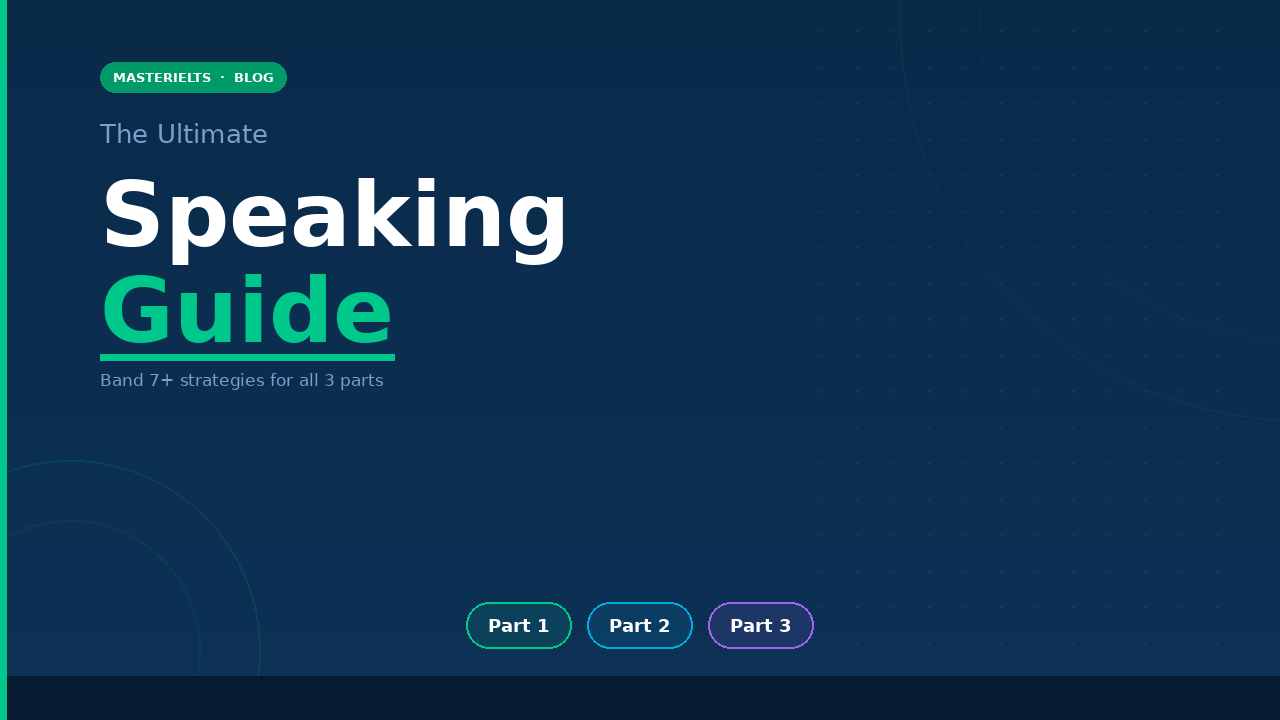
The Ultimate IELTS Speaking Guide 2026
TL;DR / Quick Summary
Most test-takers dread the IELTS speaking test more than any other section. That is understandable. Sitting across from a stranger, being recorded, and producing fluent English under pressure feels genuinely difficult. But here is the truth: ielts speaking is also the most learnable part of the exam. Unlike reading or listening, where the text controls you, speaking lets you shape the conversation.
This guide covers everything you need: the three-part test structure, part-specific strategies, how examiners actually score you, and a practical preparation plan. Whether you are sitting the test for the first time or resitting after a disappointing band score, this is your complete playbook.
Understanding the IELTS speaking test structure
The speaking test runs for 11 to 14 minutes and takes the same format for both Academic and General Training candidates. (Source: IELTS.org) You sit face-to-face with a certified examiner in a quiet room. The session is recorded for quality moderation purposes.
One thing that surprises many candidates: the test begins with a greeting and identity check before the first question. This is not assessed, but it does give you a moment to settle. The examiner will ask to see your identification, exchange a brief pleasantry, and then move directly into Part 1.
Understanding the structure before you walk into that room matters. When you know what is coming, nerves drop and focus increases. You can read a full breakdown of the IELTS speaking test format, including 2026 updates, in our dedicated guide.

Each part has a different purpose and demands a different style of response. Treating them identically is one of the most common preparation mistakes.
What examiners are listening for
Examiners assess you across four criteria, each weighted equally at 25%:
- Fluency and Coherence , how smoothly and logically you speak
- Lexical Resource , the range and accuracy of your vocabulary
- Grammatical Range and Accuracy , variety and correctness of your grammar
- Pronunciation , clarity and intelligibility
These four criteria are described in detail in the official IELTS speaking band descriptors, which are worth reading carefully. Many candidates focus almost entirely on vocabulary while neglecting fluency. Because the weighting is equal, that imbalance costs marks.
IELTS speaking Part 1: the warm-up and foundation
Part 1 covers familiar, personal topics: your hometown, accommodation, work or studies, hobbies, food, technology, and similar everyday subjects. The examiner asks short questions and expects relatively brief answers, typically two to four sentences each.
The most common mistake here is giving one-word or one-sentence responses. "Yes, I enjoy cooking" is not enough. Neither is a rehearsed paragraph that sounds memorised. The examiner wants natural, conversational English that shows you can communicate comfortably about everyday life.
Part 1 matters more than candidates often realise. Examiners begin forming an impression of your fluency and listening comprehension from the very first answer. A strong start builds momentum; a hesitant, clipped start puts pressure on Parts 2 and 3 to recover the impression.
Common Part 1 topics and how to handle them
High-frequency Part 1 topics include hometown and accommodation, family and friends, work and studies, hobbies and interests, food and cooking, and daily routines. (Source: British Council IELTS preparation materials)
You do not need to prepare scripted answers for every possible topic. You need to practise extending your answers naturally, whatever the subject. The question "Do you enjoy cooking?" is an opportunity, not a threat.
The art of extending your answers
Five techniques turn a thin answer into a full one:
- Reasons , "because" or "since" followed by your explanation
- Examples , "For instance," or "A case in point..."
- Detail , specific description that adds texture
- Temporal depth , reference to the past or future ("I used to...", "I'd like to...")
- Speculation , "I suppose," "I imagine," showing you can engage thoughtfully
Here is the difference in practice:
Thin answer: "Yes, I like cooking."
Extended answer: "Yes, I really enjoy it, actually. I find cooking quite relaxing after a long day at work. I tend to cook Italian food mostly, because I lived in Milan for a year and picked up some recipes there. I am not very adventurous, but I am gradually trying more challenging dishes."
That extended answer covers a reason (relaxing), a detail (Italian food), a past reference (Milan), and honest self-reflection. It is conversational and authentic, not rehearsed.
IELTS speaking Part 2: the long turn strategy
Part 2 is the "long turn." You receive a cue card with a topic and four or five bullet points, take one minute to prepare notes, and then speak for up to two minutes without interruption.
This section makes many candidates nervous because sustained solo speech feels unnatural. But I would argue it is actually an opportunity. For two minutes, you control the narrative entirely. There are no follow-up questions to derail you and no examiner interruptions to manage.
The biggest mistake candidates make in Part 2 is memorising model answers. Examiners detect scripted speech quickly, and if your cue card topic differs even slightly from what you prepared, your entire answer collapses. What you want instead is a flexible structure that you can fill with any topic on the day.
Explore our guide to speaking IELTS Part 2 topics and topic Part 2 IELTS speaking cue cards for full cue card practice with sample answers.
Decoding the cue card
A typical cue card might look like this:
Describe a hobby or interest that you enjoy.
- What it is
- When you started doing it
- Why you enjoy it
- How it affects other areas of your life
The bullet points are structural prompts, not a rigid script you must follow in order. They tell you what content the examiner expects, but you can rearrange them if your answer flows better that way.
Read each bullet point and ask: is this asking me to describe, explain, evaluate, or reflect? That quick interpretation during your preparation minute saves you from rambling.
The one-minute preparation: how to plan without memorising
Use your one minute to write key words only, not sentences. Jot down a rough structure and one or two concrete examples you will mention. The goal is to give yourself an anchor, not a script.
Sample notes for "Describe a hobby you enjoy":
- Hobby: photography
- Started: university, borrowed friend's camera
- Why: creative outlet, notice details
- Effect: travel more, different perspective on places
With those four anchors, you can speak naturally for two minutes. Without them, you risk either rushing or drying up at the 90-second mark.
A structure for a Band 8 Part 2 response
A reliable three-section framework:
- Introduction (10 to 15 seconds): name the topic and set the scene
- Main content (75 to 90 seconds): develop two bullet points fully with specific examples and detail
- Reflection (10 to 15 seconds): explain what it means to you or how you feel about it
This paces naturally to two minutes without padding or rushing.
IELTS speaking Part 3: the advanced discussion
Part 3 is where Band 7 and Band 8+ candidates separate. The examiner asks four to eight abstract, open-ended questions connected to the Part 2 topic, but they shift the discussion to broader themes: society, trends, causes, predictions, and comparisons.
A typical transition might be: you described your hobby of photography in Part 2, and Part 3 then asks about the role of social media in how people share images today, or whether photography has made people less present in the moment. The questions move away from personal experience and into analysis.
Many candidates find Part 3 unsettling because the questions feel unpredictable. The good news is that roughly 90% of Part 3 questions follow recognisable patterns. Once you know those patterns, no question is truly unexpected.
Nine question types to recognise
- Give your opinion , "Do you think...?" / "What are your views on...?"
- Express a preference , "Which would you say is more important...?"
- Describe people or trends in your country , "How do people in your country tend to...?"
- Causes and effects , "Why do you think...?" / "What are the consequences of...?"
- Compare and contrast , "How does X differ from Y?"
- Make predictions , "Do you think this will change in the future?"
- Compare past and present , "How has this changed over the years?"
- Hypotheticals , "If... what would happen?"
- Propose solutions , "What could be done to address...?"
When you hear a Part 3 question, your first task is to identify which type it is. That tells you exactly what structure your answer needs.
Developing complex answers
A basic Part 3 answer layers four components:
- State your position clearly
- Explain the reason behind it
- Support with a concrete example or comparison
- Optionally, acknowledge a counterpoint
This takes a one-sentence gut reaction and turns it into a five to seven sentence response that demonstrates analytical thinking. That is the difference examiners are listening for at Band 8.
Handling unfamiliar topics
Sometimes a Part 3 question covers territory you genuinely know little about. That is fine. You can acknowledge it honestly: "I haven't given this much thought before, but from what I understand..." or pivot to related experience: "I can't speak to the global picture, but in my experience..."
Examiners are trained to accept this kind of honest framing. What they do not accept is faking expertise in a way that produces vague, meandering non-answers. If you are uncertain, say so briefly and then develop whatever genuine perspective you do have.
The four marking criteria explained
Understanding how you are scored removes a great deal of exam anxiety. Here are the four criteria in practical terms.
Pronunciation and intelligibility
The examiner does not expect a native-like accent. The question is whether your speech is intelligible: can they understand what you are saying without difficulty? (Source: IELTS.org band descriptor documentation)
Three components matter: individual sound clarity, word stress (saying present with stress on the first syllable as a noun, second as a verb), and sentence-level intonation. Candidates with strong regional accents frequently score well on pronunciation because their speech is clear and natural, even if their accent is non-British or non-American.
The concern is not where your accent comes from. It is whether your pronunciation interferes with communication.
Fluency and coherence
Fluency means smooth, effortless speech. It does not mean fast speech. Coherence means your ideas connect logically so the examiner can follow your thinking.
One tension candidates face is the self-correction dilemma. You notice you have made a grammar error mid-sentence. Do you stop and correct it? My recommendation: correct only significant errors, and do so once, cleanly. Repeatedly restarting sentences destroys fluency. A single clean correction ("I were... I was at university when I first became interested in it") actually signals grammatical awareness, which is positive.
Discourse markers help coherence considerably: "So, to go back to what I was saying," "What I mean by that is," "That said," "On the other hand." These signal logical organisation without sounding rehearsed.
Lexical resource and vocabulary
Many candidates believe using sophisticated vocabulary guarantees a high score. This is a misunderstanding. Lexical resource assesses whether your vocabulary is varied, accurate, and appropriately used. Using complex words incorrectly, or forcing them into contexts where simpler words work better, actually reduces your score.
A Band 8 response uses vocabulary that is precise and natural, including less common words where they fit naturally. A Band 6 response either repeats the same basic words or misuses advanced ones. The goal is a wide vocabulary deployed accurately and naturally, not a display of the most impressive words you know.
Grammatical range and accuracy
Grammatical perfection is not required. Band 8 requires consistent accuracy across a range of sentence structures: simple, complex, conditional, and passive constructions. Examiners listen for your ability to manipulate language, not your ability to avoid all errors.
Native speakers make small grammatical slips in natural speech. What distinguishes Band 8 is overall control and variety, not a flawless transcript.
Proven preparation and practice strategies for IELTS speaking
Now for the practical side. How do you actually improve?
Daily practice beats weekend cramming. Speaking is a motor skill as much as a cognitive one. Consistency across weeks produces far better results than intense practice sessions the night before the exam.
Solo practice techniques that work
Recording yourself is the single most effective solo practice method. Speak for two minutes on a Part 2 topic, then listen back. You will notice things you never noticed while speaking: excessive hesitation, repeated vocabulary, unclear pronunciation, or missed opportunities to extend an answer.
The key is treating the recording as feedback, not just performance. Ask yourself after each recording: what would I change? Where did I hesitate too long? Did I use varied vocabulary or repeat the same words? Did my answer have a clear structure?
Without this reflective step, solo practice becomes repetition without improvement.
Practising with a partner
A conversation partner changes your practice in ways solo recording cannot. You get unpredictable questions, real-time pressure, and honest feedback. Language exchange apps, online tutors, and English-learning communities are all practical options for finding a partner, even if you are preparing independently.
Effective partner practice uses real IELTS questions, involves timing each answer, and includes specific feedback rather than vague encouragement. "That was good" tells you nothing. "You used 'interesting' four times in Part 1" is useful.
Using real practice materials
Use authentic materials wherever possible. The British Council offers free speaking practice tests with real examiner recordings. IELTS.org publishes official sample tasks for all three parts.
Aim for one to two full mock tests per week in the month before your exam. A full mock means 11 to 14 minutes of continuous speaking, not individual question practice. Test-day stamina is a real factor.
Common mistakes to avoid during preparation
- Memorising answers. Examiners detect this quickly, and it fails the moment the question varies.
- Only practising easy topics. Comfort zone practice produces comfort zone results.
- Speaking without listening back. You cannot improve what you cannot hear.
- Focusing on one marking criterion. Equal weighting means equal preparation.
- Ignoring Part 3. Many candidates under-prepare for abstract discussion because it feels harder to practise. That is exactly why it matters.
Final test-day tips and confidence building
The 24-hour pre-test warm-up
In the 24 hours before your test, speak, listen to, and read English as much as possible. Watch English-language programmes, listen to podcasts, have a conversation if you can arrange one. This is not last-minute cramming. It is priming your language production so that English flows more readily when you sit down with the examiner. (Source: British Council preparation guidance)
Managing anxiety in the room
Nerves are normal. Slight hesitation is acceptable. The examiner has assessed thousands of candidates and is not judging you personally. Their job is to assess your English, not to make you feel uncomfortable.
Reframe the interaction: this is a conversation with a professional listener, not a performance for a hostile audience. Speak clearly, maintain natural eye contact, and remember that confident posture produces confident speech, even when you do not feel particularly confident internally.
If you do not understand a question
Ask for clarification. This is not penalised. Realistic communication involves asking for clarification, and the examiner knows this.
Useful phrases:
- "I'm sorry, could you explain what you mean by [word]?"
- "Could you rephrase that, please?"
You cannot ask them to repeat the entire question repeatedly, but clarifying a specific term is entirely appropriate and will not cost you marks.
Frequently asked questions
How long is the IELTS speaking test?
The IELTS speaking test lasts 11 to 14 minutes in total across all three parts. Part 1 runs for four to five minutes, Part 2 involves one minute of preparation plus up to two minutes of speaking, and Part 3 runs for four to five minutes. The overall duration varies slightly depending on examiner pacing and candidate responses.
Is the IELTS speaking test the same for Academic and General Training?
Yes. The speaking test format is identical for both Academic and General Training IELTS. The same three-part structure, the same timing, and the same four marking criteria apply regardless of which version of the exam you are sitting. (Source: IELTS.org)
What band score do I need for immigration or university?
Requirements vary. UK Visas and Immigration typically requires a minimum of Band 6 or 6.5 overall for skilled worker routes, with specific requirements depending on the visa category. Most UK universities require between Band 6 and 7.5 for postgraduate admission, with individual departments setting their own thresholds. Always check the specific requirements of your target institution or visa application. (Source: UK Visas and Immigration official guidance)
Can I improve my IELTS speaking score by using a foreign accent?
Your accent does not determine your score. The pronunciation criterion assesses intelligibility and clarity, not whether your accent matches a British or American standard. Examiners receive training to understand a wide range of accents. What matters is whether your pronunciation allows the examiner to understand you easily and consistently.
What happens if I go blank during Part 2?
Use a recovery phrase to buy yourself a second: "Let me gather my thoughts for a moment," or simply pause briefly and then continue. If you lose your thread entirely, return to your preparation notes, pick the next bullet point, and move forward. Going blank briefly is not catastrophic. Stopping entirely is. Keep speaking, even if you briefly simplify what you are saying.
How soon after the test will I receive my speaking score?
For paper-based IELTS, results are typically available 13 days after the test. For IELTS on computer, results are often available within 3 to 5 days. Speaking results form part of the overall band score report, not a separate notification. (Source: British Council IELTS results information)
Conclusion
IELTS speaking rewards preparation that is structured and honest. Know the three-part format, understand what each part demands, practise with real questions, record yourself, and study the marking criteria so you know exactly what examiners are assessing.
The test is learnable. Improvement comes from identifying your specific weaknesses and targeting them directly, not from generic practice that keeps you comfortable.
Start with one area. If Part 1 answers feel thin, work on answer extension this week. If Part 2 structure feels uncertain, practise the three-section framework daily. If Part 3 feels intimidating, learn the nine question types and write one practice answer for each.