IELTS Speaking Part 2 Topics: Cue Cards + Answers
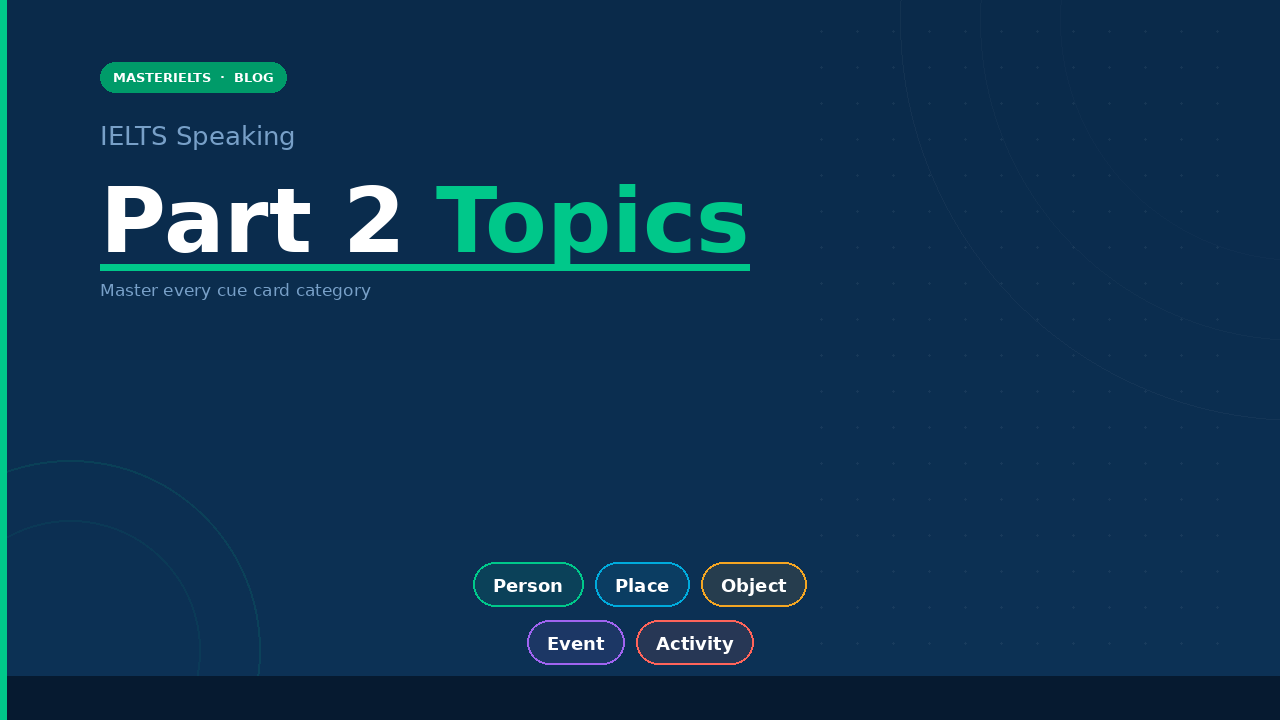
Most candidates waste weeks memorising dozens of individual topics when the real skill is recognising patterns. The speaking IELTS part 2 topics that appear on cue cards fall into a small number of repeating categories: Person, Place, Object, Event, and Activity. Once you understand that structure, you can prepare for nearly any card you receive.
This guide covers the most common cue card categories, a short sample answer for each, and the strategies that separate Band 7+ responses from average ones. Mater IELTS give you a full overview of the speaking test.
How IELTS Speaking Part 2 actually works
You receive a cue card with a topic and three or four bullet-point prompts. You have one minute to prepare, then speak for one to two minutes while the examiner listens. The examiner does not interrupt during your answer.
Your score depends on four criteria set by Cambridge Assessment English (Source: IELTS.org):
- Fluency and coherence , smooth, connected speech
- Lexical resource , range and accuracy of vocabulary
- Grammatical range and accuracy , sentence variety and correctness
- Pronunciation , clarity, stress, and intonation
One thing most pages in the SERP skip: topic choice does not determine your score. Delivery and language do. A confident, detailed answer about your morning commute scores higher than a hesitant, vague answer about travelling through twelve countries.
Use your one-minute preparation time to plan, not to write out sentences. Jot two or three keywords under each bullet point, decide on a specific example, and roughly map a beginning, middle, and end. That structure alone gives you something to follow when nerves kick in.
The five speaking IELTS part 2 topics categories
Top-ranking resources from IELTS Liz and IELTS Buddy both organise topics into semantic categories. Below are the five most common, each with a real cue card example and a short sample answer showing what a Band 7 response looks and sounds like.
Person topics
Sample cue card: Describe an older person you know and respect. You should say: who this person is, how you know them, what they are like, and explain why you respect them.
Sample answer (Band 7 target): "I'd like to talk about my grandmother. She raised five children mostly on her own after my grandfather passed away when my mother was still young. What strikes me about her is that she rarely complains, even now in her eighties, and she has this quiet determination that I find genuinely admirable. I respect her because she made difficult decisions under real pressure, and she did it without making anyone feel like a burden. She taught me, largely by example, that resilience is not dramatic. It's just continuing."
Why it works: Specific detail (five children, grandfather's death, her age), a clear reason for admiration, and a closing reflection that adds depth without going over time.
Place topics
Sample cue card: Describe a place you find peaceful. You should say: where it is, what it looks like, when you go there, and explain why you find it peaceful.
Sample answer (Band 7 target): "There's a small reservoir about twenty minutes from where I grew up. I go there in the early morning when the water is still and the light is grey and flat. There are no cafes or benches, just a path around the edge and a few ducks. I find it peaceful precisely because nothing is designed to entertain you. You just walk and think. I go when I need to make a decision about something, and I almost always leave with more clarity than when I arrived."
Why it works: Sensory detail (grey flat light, no benches), a specific reason grounded in personal experience, and a clear explanation of why it matters.
Object topics
Sample cue card: Describe a gift you received that meant a lot to you. You should say: what it was, who gave it to you, when you received it, and explain why it was meaningful.
Sample answer (Band 7 target): "My father gave me a secondhand dictionary when I was about twelve. It was old, and some of the pages were water-stained. He had used it at university and wrote notes in the margins. I still have it. At the time I didn't really understand why he chose that particular gift, but I've come to think he was trying to show me that language is a tool, not just something you're tested on. The margin notes are the part I treasure most because they show how he thought."
Event topics
Sample cue card: Describe a time you received good news. You should say: what the news was, when you received it, who told you, and explain how you felt.
Sample answer (Band 7 target): "I found out I'd been accepted onto my degree programme while I was at work. A colleague was talking to me about something entirely unrelated when my phone buzzed, and I glanced down and saw the email subject line. I had to read it three times. I didn't say anything to my colleague immediately because I needed a moment to be sure I hadn't misread it. The feeling was less like excitement and more like relief, which surprised me. I think I'd been more anxious about it than I admitted to myself."
Activity topics
Sample cue card: Describe a type of exercise you enjoy. You should say: what it is, when you do it, who you do it with, and explain why you enjoy it.
Sample answer (Band 7 target): "I've been swimming regularly for about three years. I go twice a week, usually early in the morning before the pool gets busy. I swim alone, which I prefer, because it's one of the few activities where I genuinely can't look at my phone. The rhythm of it is what keeps me coming back. After about twenty lengths my mind stops running through my to-do list and I feel properly settled. It's not exciting to describe, but it works better than anything else I've tried for managing stress."
For detailed practice on specific cue card formats, Master IELTS covers additional card types with structured practice exercises.
Common mistakes that cost candidates marks
The SERP research for this topic shows that competing pages list topics but rarely explain what goes wrong in real answers. Here are the errors that appear most often:
Memorised answers: Examiners can identify a rehearsed script immediately. Fluency drops when candidates reach a part they haven't memorised, and the response stops sounding authentic. Prepare frameworks and vocabulary, not full scripts.
Ignoring the bullet points: Candidates often develop one or two prompts in depth and skip the others. Touch all four prompts, even briefly. The card is a structure, not a suggestion.
Vague or generic language: "It was a nice experience and I really enjoyed it" tells the examiner nothing. If you removed your name and someone else read your answer, would it still be specific to you? If not, add a real detail.
Speaking too fast: Speed often signals anxiety, not confidence. Aim for approximately 130 to 150 words per minute. Pause between sentences. Examiners need to assess your pronunciation and coherence, not just count words.
Long silences: A pause of five or more seconds is marked as hesitation. Use a short linking phrase ("What I mean is..." or "Let me think about that for a moment") to stay connected to your answer while you gather your next thought.
Connecting Part 2 to Part 3
Part 3 follows directly from your Part 2 topic, but shifts from personal experience to broader discussion. If your cue card was about a person you admire, Part 3 might ask "What qualities do you think make someone a good role model?" or "Has the idea of who people admire changed over time?"
The pattern is consistent: personal narrative (Part 2) expands into opinion, comparison, or cause-and-effect (Part 3). Candidates who prepare for both together are far less likely to be caught off guard.
A useful transition phrase: "Well, building on what I mentioned about [topic], I think more broadly..." This connects your personal example to the abstract question naturally.
Frequently asked questions
What are the most common speaking IELTS part 2 topics?
Person, Place, Object, Event, and Activity are the five recurring categories. Within those, topics relating to people you admire, memorable experiences, everyday objects, and leisure activities appear most frequently across reported exam papers.
How long should my Part 2 answer be?
Aim to speak for the full one to two minutes. A well-structured answer with a short introduction, two or three developed points, and a brief closing reflection will usually reach two minutes naturally without padding or rushing.
Can I use the same speaking strategy for every cue card?
Yes, the core framework is consistent: identify the topic category, note keywords under each bullet point during preparation, open with a clear statement, develop two or three specific points with personal examples, and close with a reflection or reason why the topic matters to you.
What should I do if I run out of things to say?
Ask yourself: "Can I give an example?" or "Why does this matter to me?" These mental prompts extend answers without sounding like filler. You can also add a contrasting detail ("Although one thing that surprised me was...") to buy time and deepen your response.
Do I need to cover all the bullet points on the cue card?
Yes. Examiners use the bullet points as part of their assessment. Missing one or two entirely signals a gap in comprehension or preparation. Cover all four, even if some receive less development than others.
Conclusion
The speaking IELTS part 2 topics you will face are not random. They follow five predictable categories, and the same preparation strategies apply across all of them: plan during your one minute, speak to every bullet point, use specific personal details, and explain why the topic matters to you rather than just describing what happened.
Record yourself answering practice cue cards and listen back. Most candidates are surprised by how quickly they improve once they can hear their own pacing, vocabulary choices, and fluency markers.